4-ACO-DMT, Psilocybin~ Albert Hofmann
May 29, 2026

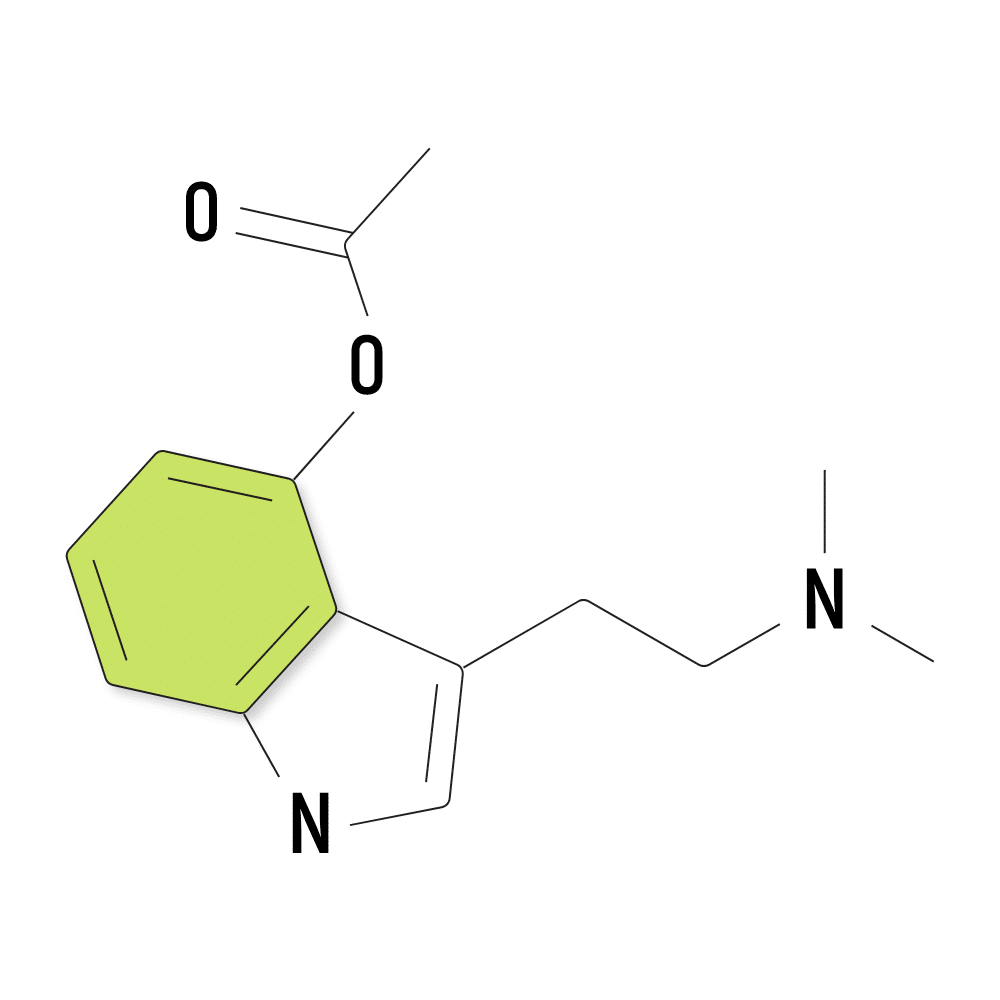
4-AcO-DMT — often called synthetic shrooms — is a prodrug that converts into psilocin, the psychoactive compound found in magic mushrooms.
Its effects are nearly impossible to tell apart from those of magic mushrooms, with only a handful of subtle subjective distinctions.
Patents on this long-established compound lapsed decades ago — a problem for firms such as Compass Pathways that are trying to corner the synthetic psilocybin market over the coming 20 years.
Below is everything worth knowing about 4-AcO-DMT.
So, What Exactly Is 4-AcO-DMT?
The name 4-AcO-DMT is short for 4-Acetoxy-DMT. It was created by Albert Hofmann — the man behind LSD (lysergic acid diethylamide) — together with his colleague Franz Troxler. The pair developed it in the early 1960s while investigating the active compounds in psychedelic mushrooms.
4-AcO-DMT is derived from psilocin, the primary pharmacological component of magic mushrooms. The liver converts both psilocybin and 4-AcO-DMT into psilocin, and that is what produces the psychoactive effects.
Because of this, the effects of 4-AcO-DMT closely mirror those of psilocybin or psilocin.
The company the team was working for — Sandoz — filed for a patent in January of 1963 but never got a chance to exploit it for any profit. They simply didn’t know what to do with this or any of Hofmann’s psychoactive substances (including LSD and psilocybin).
This all took place just shortly after the Harvard Psilocybin project — which was run by Timothy Leary and Richard Alpert. Sandoz was giving Leary large quantities of LSD for the sake of studying it in search of potential lucrative applications in the field of psychotherapy.
4-AcO-DMT was shelved for several decades until the late 90s when a man by the name of David E. Nichols began campaigning for the use of the substance in psychedelic-assisted psychotherapy. He aimed to motivate researchers to take a closer look at this compound so it could eventually make its way into the medical system. Nichols favored it for its reliability of effects, cost-effectiveness, and sheer potency.
Unfortunately, there has yet to be a single clinical study on the effects of 4-AcO-DMT. Most of the information currently available comes to us from animal studies and anecdotal reports.
Despite how poorly this drug has been studied, 4-AcO-DMT is one of the most popular synthetic psychedelics, falling behind LSD and ketamine but higher than 2C-B, Dipt, or other drugs in the 2C-X family.
4-AcO-DMT is a whitish brown powder in its raw form, most often sold in capsules or tablets.
 4-AcO-DMT
: Specs & Technical Details
| Chemical Name | 4-Acetoxy-DMT |
| Level of Risk | Low |
| Other Names | Synthetic Shrooms, Psilacetin, 4-acetoxy-DMT, or 4-AcO-DMT |
| Most Common Side-Effects | Anxiety & Paranoia |
| Duration of Effects | 2–6 hours |
| Legality | Illegal in most countries, legal in Canada |
What Is the 4-AcO-DMT Experience Like?
Broadly speaking, 4-AcO-DMT reproduces the effects of psilocybin mushrooms. The compound itself isn’t the active agent — its main metabolite, psilocin, is. That makes 4-AcO-DMT a prodrug of the naturally occurring psychedelic psilocin.
In lower doses (up to 30 mg), 4-AcO-DMT and magic mushrooms are virtually indistinguishable. It produces auditory and visual hallucinations, enhances introspection and existential thought processes, suppresses the default mode network (DMN), and alters the perception of time and sensory information.
In higher doses (over 30 mg), the effects of 4-AcO-DMT begin to change. This dose is very powerful and is much more similar to DMT. The visuals become much more fractal and geometric, and the hallucinations and sense of empathy and introspection become very intense.
The existential weight of this substance, especially in higher doses, is one of the main reasons why so many people only use this drug once. High doses of 4-AcO-DMT are much more likely to cause terrifying or uncomfortable trips than high doses of magic mushrooms, but it isn’t clear why this is the case.
Through our trip surveys, we’ve received 11 reports of people using 4-AcO-DMT. Most people took between 20 and 30 mg and reported the effects to be very similar to magic mushrooms but a bit mellower.
Common Reported Effects from 4-AcO-DMT:
- Introspection
- Altered perception of time
- Fractal geometric patterns
- The perception of music changes, sometimes for worse, sometimes better
- Full-body floating sensation
- Euphoria
- Ego-dissociation
How Long Do the Effects of 4-AcO-DMT Last?
Duration is one of the key differences between 4-AcO-DMT and shrooms. The compound typically lasts between 2 and 6 hours. Only rarely does it stretch to a full 8 hours the way magic mushrooms can.
If you take 4-AcO-DMT on an empty stomach or snort the powder rather than consume it as a capsule, the effects are going to begin and end sooner.
For example, if you take 4-AcO-DMT in capsule form, expect it to take up to 45 minutes to start taking effect. Peak experience begins around the 2-hour mark, which gradually tapers off over the next 2–4 hours.
If you insufflate (snort) the powder, the effects come on within about 15 minutes, reach peak effect by the 1-hour mark, and taper off over the following 2 or 3 hours.
What Dose of 4-AcO-DMT Should You Take?
A major advantage of 4-AcO-DMT — and the reason figures such as David Nichols champion it — is how reliably its effects show up.
Since this is a pure compound with a fast and predictable metabolism, the potency of effects is much easier to gauge than the more natural psychedelics. Plants and fungi are harder to dose because the concentration of active ingredients can vary widely from one sample to the next.
The general dose of 4-AcO-DMT ranges from 10 to 30 mg. Some people take less (microdose), others take more (heroic dose). A 20 mg dose is roughly equivalent (subjectively) to 3 grams of dried psilocybin mushrooms.
If you’re new to using 4-AcO-DMT, it’s wise to start on the low-end of the spectrum and increase gradually over time.
The type of 4-AcO-DMT has a slight impact on the dose. For example, if using 4-AcO-DMT fumarate salt, you need about 1.24 mg of powder. If using 4-AcO-DMT hydrochloride salt, you need a bit less, at 1.15 mg of powder. The dose is also about 20% lower if insufflating the active ingredients rather than consuming them orally.
Here’s some general dosage information to get you started:
Microdose — 1–2 mg
Threshold Dose — 5 mg
Light Dose — 10 – 20 mg
Standard Dose — 20–30 mg
Heroic Dose — 40+ mg
4-AcO-DMT vs. Other Psychedelics
4-AcO-DMT is most similar to psilocybin and psilocin but also shares similarities with other indole alkaloids like LSD, N,N,DMT, and 5-MeO-DMT. It’s a homolog of other psychoactive research chemicals like 4-AcO-MET, 4-AcO-DET, 4-AcO-MiPT, and 4-AcO-DiPT.
4-AcO-DMT Compared to Psilocybin
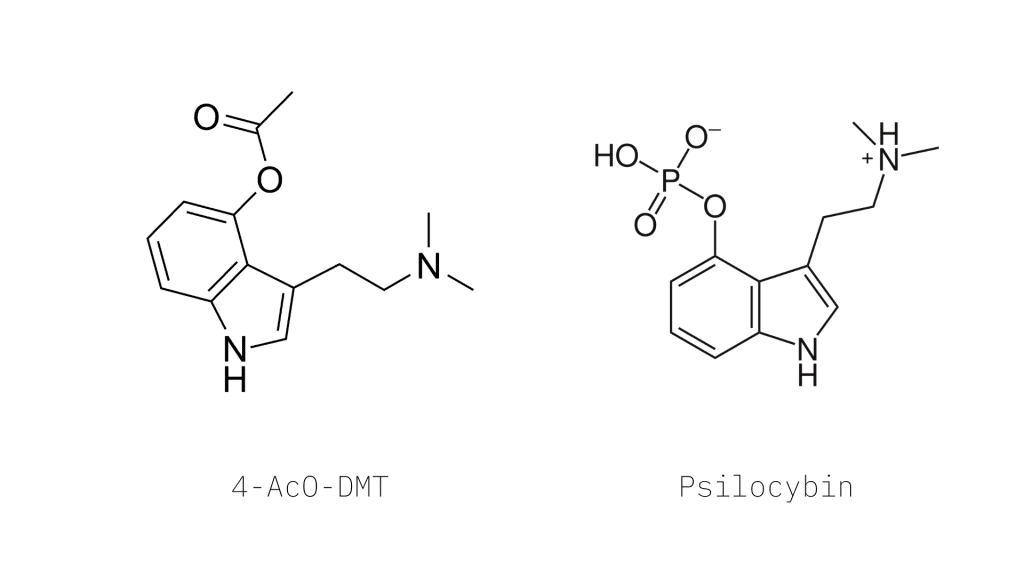
The common name for 4-AcO-DMT is synthetic shrooms. This is because once in the body, 4-AcO-DMT is metabolized exactly the same way as the active ingredients in magic mushrooms. It’s converted to psilocin, which then interacts with 5-HT2A receptors in the brain to induce the psychedelic state.
4-AcO-DMT is an analog of psilocybin (4-PO-DMT) and psilocin (4-HO-DMT). There are more similarities in these substances than differences, and most people will be unable to tell the difference between the 4-AcO-DMT experience and magic mushrooms or even synthetic psilocybin.
There are a few subtle differences between these substances, however.
For example, 4-AcO-DMT is more mellow than magic mushrooms — when used in lower doses. It’s more calm, introspective, and sharper. Magic mushrooms tend to cause feelings of fuzziness. It can be difficult to make decisions, and vision may feel blurry. This isn’t as pronounced when using 4-AcO-DMT.
Another difference comes from the onset times. 4-AcO-DMT is relatively fast-acting, especially if you take it on an empty stomach or insufflate it. Magic mushrooms can take an hour or more to start taking effect, while 4-AcO-DMT usually kicks in within about 30 or 45 minutes.
4-AcO-DMT is also much less likely to lead to nausea — an effect that’s very common when consuming magic mushrooms. The likely explanation for this is that 4-AcO-DMT doesn’t contain any of the chitin or fibers present in magic mushrooms that can irritate the digestive lining.
In higher doses, 4-AcO-DMT starts to differentiate itself from magic mushrooms. In high doses (over 40 mg), the effects are more similar to DMT. It induces powerful fractal and geometric hallucinations and profound existential “realizations” — even more so than high doses of magic mushrooms.
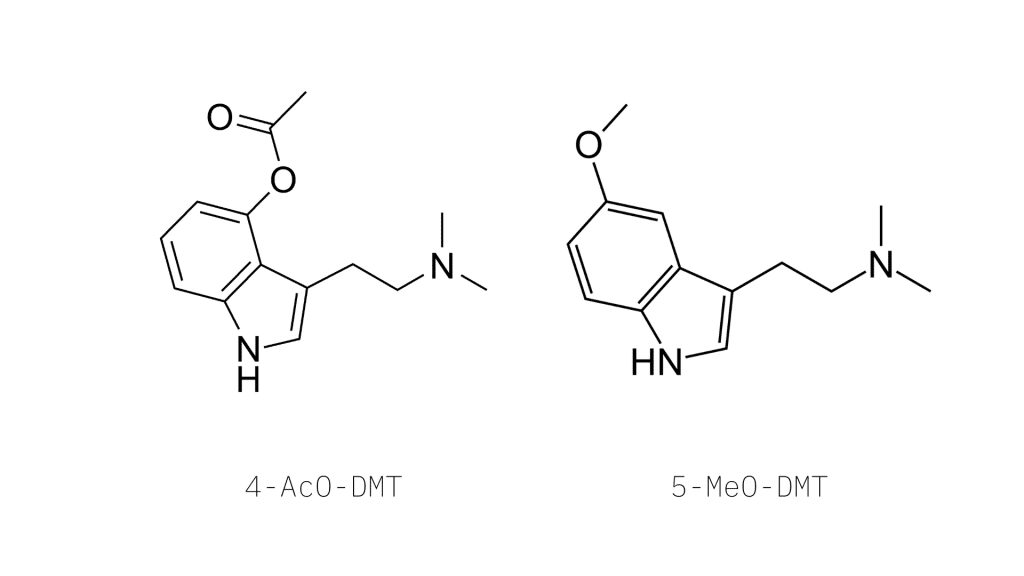
4-AcO-DMT Compared to 5-MeO-DMT
Structurally, 4-AcO-DMT and 5-MeO-DMT — the psychedelic substance secreted by the Bufo alvarius toad —are very similar.
While the effects are similar too (both compounds activate the 5-HT2A receptors), the potency of the experience is radically different.
Synthetic shrooms induce similar psychedelic experiences as magic mushrooms, LSD, 2-CB, and LSA. It can change how we perceive time and space, alter our interpretation of sensory information, and opens up the mind to a higher degree of entropy. Higher entropy is thought to contribute to the mystical experience and existential realizations that come along with these experiences.
Conversely, 5-MeO-DMT is a whole other level. The experience is exceptionally profound and nearly impossible to describe in words. Users often have entirely out-of-body experiences where they lose touch with reality and existence as they know it.
The other main difference is duration. 5-MeO-DMT lasts about 15 to 30 minutes, while 4-AcO-DMT usually lasts more than 2 hours and up to 6 hours.
4-AcO-DMT Compared to LSD
The effects of 4-AcO-DMT and LSD or LSD alternatives are comparable but have unique characteristics to each.
LSD tends to be more visual and clear-headed, while 4-AcO-DMT has more of a body high and tends to be “more grounding.”
Both compounds target the same receptors, albeit with different ratios of binding strength. The main target is the 5HT2A receptors, which is what produces the majority of the psychedelic effects.
You’ll often see 4-AcO-DMT alongside a compound called 1P-LSD in online shops (especially in Canada where both compounds are legal). 1P-LSD is the prodrug for LSD in the same way that 4-AcO-DMT is the prodrug for psilocybin.
Other LSD derivatives that share similar comparisons include PRO-LAD, AL-LAD, LSZ, ETH-LAD, and ALD-52.
How Safe Is 4-AcO-DMT?
4-AcO-DMT carries a notably favorable safety profile. Interest in it has grown steadily over the past decade, and no major safety concerns have ever been raised about its use.
Like most indole alkaloids (psilocybin, psilocin, LSD, DMT, LSA), there are very few negative side effects on the body, even in high doses.
All of these substances have been rigorously tested to explore their safety profiles. There’s never been a reported death to anybody using just 4-AcO-DMT. There have been some deaths associated with other drugs.
As with any psychedelic substance, there’s some risk of psychological harm from using this substance. It’s possible the use of 4-AcO-DMT could worsen or trigger psychotic breaks.
Powerful psychedelic experiences can also lead to ontological shock if the individual wasn’t ready or didn’t have the resources to integrate the experience effectively. This can lead to long-term psychological harm, including post-traumatic stress disorder (PTSD), depression, and anxiety.
The main safety concerns of this substance are the dose (it’s relatively easy to take too much) and adulteration with potentially harmful ingredients like fentanyl, PCP, or NBOMe. Because it’s a chemical powder, it’s much easier to adulterate it with harmful chemicals. You should always test your 4-ACO-DMT before you assume it to be pure.
You should always test your substances with a drug testing kit. I like using the kits from Elevation Chemicals for this.
Testing 4-AcO-DMT: A Step-by-Step Guide
Testing substances with a reagent test kit is considered a key aspect of responsible substance use — especially when working with powders or liquids. Essentially, anything that isn’t a raw plant or fungus should always be tested to make sure the substance you’re using is exactly what you think it is.
Please note that reagent testing will show you what types of compounds are present in a sample, but it doesn’t tell you how pure it is. This is done as a harm reduction step and does not prove the sample you’re using is completely safe.
Testing only requires a small sample of your substance, and reagents are very cheap. You only need a drop for each test and a sample the size of a grain of sand in order to run the test. Testing is cheap, fast, and high-yield in terms of ensuring safety.
With that aside, here’s how to test 4-AcO-DMT:
In a perfect world, you’d run four tests using the Ehrlich, Marquis, Mecke, and Mandelin reagents. Each one tests for a different compound.
If you’re pressed on a budget, the most important test would be the Ehrlich reagent — which is designed to detect the presence of indole alkaloids. If this test fails (AKA it doesn’t change to a purple color), the substance you have is not 4-AcO-DMT, and you should avoid it at all costs.
Take a small sample and place it on a white ceramic or plastic surface to run the test. The sample should be the size of about one grain of salt. Next, drop one drop of the test reagent over the sample and note how long it takes to change color. Wait 3 minutes to allow the reaction to complete before noting the color.
Here’s what to expect if your sample is 4-AcO-DMT using the four test reagents noted above:
- Ehrlich — Used to detect indole alkaloids. It should turn purple within 2 minutes.
- Marquis — Used to detect amphetamines. Should not change color.
- Mecke — Used to detect the presence of opioids. Light green or blue color indicates the presence of opiates. May turn a dark green color.
- Mandelin — Used to differentiate some alkaloids. Should remain yellow, or turn a darkish green (not red, black, or orange)
Side Effects of 4-AcO-DMT
Concentrated 4-AcO is very potent. You only need a few mg of powder to get a hefty dose, unlike mushrooms which involve several grams to hit the ideal dose. If you take a few mg too many magic mushrooms, there isn’t going to be any major shift in the effects. With 4-AcO-DMT, even just a few mg more can result in a big change in the experience.
Large doses of 4-AcO-DMT are more likely to lead to a more challenging trip than lower doses, which tend to be mellow and positive.
With that said, physical side effects are rare with 4-AcO-DMT. Here are some of the side effects that were reported by submissions in our trip surveys for 4-AcO-DMT, along with personal experience.
Potential side effects of 4-AcO-DMT Include:
- Nausea & vomiting
- Dizziness
- Anxiety
- Paranoia
- Heart palpitations
- Headaches
- Flushing in the face and chest

Is 4-AcO-DMT Legal?
4-AcO-DMT is caught in a bit of a legal grey area in most parts of the world. It’s gone relatively unnoticed by regulators and isn’t mentioned by name on any prohibited substances lists in the United States, Canada, or the UN Convention on Psychotropic Substances.
This compound is technically legal in Canada and is widely available from sources online.
In the United States, things are a little bit different. While not specifically named, 4-AcO-DMT is an analog of psilocin, which is illegal. Under the Federal Analogue Act, 4-AcO-DMT is technically considered a Schedule I drug — though it’s unlikely for arrests to be given for possession of this substance — it’s entirely possible.
In the UK, 4-AcO-DMT is listed as a Class A drug under the Misuse of Drugs Act of 1971.
In Australia, 4-AcO-DMT is classified as a Schedule 9 — which means it’s only legal if the seller is granted special access from the government. We have not been able to find any examples of legal sources for 4-AcO-DMT in Australia, and it appears they aren’t giving out licenses for this substance.
Related: List of legal psychoactive substances.
How 4-AcO-DMT Works
Like most indole psychedelic alkaloids, 4-AcO targets the 5-HT2A serotonin receptors. These receptors are thought to work by suppressing the default mode network (DMN) in the brain.
This network is responsible for controlling the communication between other regions of the brain. It acts as a reducing valve, limiting the information that comes into the brain and suppressing certain activities within the brain. The point of this system is to make us more efficient and prevent us from being overwhelmed at trivial events.
When the DMN is suppressed through the use of psychedelics like 4-AcO-DMT, this reducing valve is left wide-open. This allows a much higher level of activity in the brain in response to introspective thoughts and sensory perception.
This state enhances our out-of-the-box thinking and creativity, alters the way we perceive time and sensory information, and brings up memories and emotions that are otherwise suppressed within the brain. This leads to visual and auditory hallucinations, a deep state of introspection, ego-death and dissolution, and a strong feeling of connectedness with the world around us.
This experience is shared by most of the indole and phenethylamine psychedelics. All of these compounds target the same receptors to exert their effects but have different affinities for other serotonin receptors, as well as NMDA receptors, GABA, and much more. This is what makes the effects of psychedelics so unique despite all doing essentially the same thing.
Frequently Asked Questions About 4-AcO-DMT
Despite being around since the 60s, there’s a lot we don’t actually know yet about 4-AcO-DMT. To date, there’s never been any high-quality clinical research on this compound and its potential role in psychotherapy or for the management of conditions like cluster headaches or anxiety. These are both areas where psilocybin has already shown a ton of promise.
Nevertheless, here are some of the most common practical questions we get asked about the use of 4-AcO-DMT:
1. What Color Should 4-AcO-DMT Be?
4-AcO-DMT comes in two main forms, each with a slightly different color.
4-AcO-DMT hydrochloride comes as a whitish brown powder. Sometimes the powder will be very fine like flour; other times, you might see some crystal formation.
4-AcO-DMT fumarate salt also has a whitish brown color but is usually a little darker than the hydrochloride salt version.
Color alone is not a reliable way to assess purity. You’ll need to use a reagent test kit for this. If you find powders that are very dark brown, black, or pure white, you should be extra skeptical and make sure you test the substance before you use it.
2. Can I Make 4-AcO-DMT at Home?
Technically, yes — you can make 4-AcO-DMT with some fairly common lab equipment and reagents — but it’s highly recommended you leave this to the professionals.
The process of synthesizing 4-AcO-DMT and related compounds isn’t overly complex, but there’s a lot of room for error in the reaction that could produce potentially harmful byproducts — not to mention, it’s highly illegal in most countries.
With that said, there is some information available on how to synthesize 4-AcO-DMT to check out if you’re interested in this topic.
Related: How to Make N,N,DMT & 5-MeO-DMT.
3. Where Can I Buy 4-AcO-DMT?
If you’re living in the United States, you’re out of luck. This compound is illegal in the US and is therefore not available from any legit sources. You can buy it from street vendors (illegal), but the chances of contamination or adulteration in these products are high. We recommend not ordering 4-AcO-DMT (or any substance) illegally.
If you’re living in Canada, you can actually buy this compound legally from places like ChemLogix. It’s actually very affordable, costing around $25 CAD for four standard doses (25 mg each).
The Future of 4-ACO-DMT
4-AcO-DMT has been around for a long time yet managed to remain entirely under the radar until about ten years ago. Since then, interest in this substance has been picking up, and it’s now one of the most common forms of synthetic psychedelics on the market today.
We expect to see interest in 4-AcO-DMT continue to grow over the coming years. There are already several companies making their own synthetic version of psilocin or psilocybin, but most of them aim to patent the final product. This will allow them to increase the cost of the product and establish a monopoly on its administration.
4-AcO-DMT has already passed its patent-protected years and is now part of the public domain. This means the compound will always remain cheap, even as psychedelics become legal and more companies step in to sell it.
This psychedelic is cheap to make, offers all the same benefits and experiences as magic mushrooms, and has extra advantages in terms of dosage consistency. 20 mg of 4-AcO-DMT will always provide the same intensity of effects — however, repeated doses of magic mushrooms could provide a wide range of intensity depending on the particular mushroom used. This makes 4-AcO-DMT a better option for use in psychedelic-assisted psychotherapy because the effects are much more predictable.